
Set aside your time, focus thoroughly on a single issue, and vanish for six months. Bill Gates organizes Think Weeks, CEOs take sabbaticals, and popular essays celebrate spending months off the grid as if this were the norm.
I wanted it, and at the same time I have three children under the age of seven, run a lifestyle business, and this week had a sick child who ruined all my routine.
The message reaching you from all parts of the internet is this: true focus means giving up your life.
Here’s what that message does to someone with an actual life.
It creates a binary. Either you disappear, which is impossible, or you don’t, which means you give up on focused work entirely.
Most people with kids, mortgages, and school pickups land on option two. They conclude they’re not disciplined enough for monk mode. So they stop trying to protect focused work at all.
The whole thing feels like a stacked deck where survival is the only attainable option.
Sad.
The big cost
Here’s what happens when you don’t have protected flow.
You pour your energy into everything.
Picture a cup full to the brim. Now pour a little into seven other cups.
Result? None of them are full.
We do this in our daily lives:
Code-switching
Handling fires like a champ
Researching and going wild on self-improvement
Optimizing everything... calories, workouts, sleep... the whole damn thing
In it, we feel like we’re doing a lot.
Really, you’re quarter-assing everything. None of it gets high enough to matter on any timeline you want.
Months pass. Nothing has jumped.
You feel busy but stagnant.
You convinced yourself you were being productive because the day was full, but full and productive are different words for a reason.
Like that full cup at the beginning, you’ve only got so much energy to burn. Stretching it out in multiple places doesn’t mean they won’t hit. It does mean that you’ll have to wait longer to see visible progress.
This is why people go monk.
They aren’t just managing the same problems from some cabin in the hills.
They go dark to focus on one thing without distraction.
It doesn’t take long to reach a flow state.
You can do this in your normal life. You’ll have to make some hard choices, but they’re worth it.
Let me explain how I came to this conclusion.
How I Got Here
I spent 16 years building a career without ever optimizing for flow.
Less money. More burnout. The money I did make was unfulfilling because I was living out of alignment.
The quicker you realize you can make good money and still feel like you’re performing for an audience you never auditioned for, the quicker you can reverse it.
I wanted to redesign, but I had no model for what that would look like. Every productivity system I found was built for someone with a different life. It felt inaccessible.
So I stayed in the status quo and did little things to reduce the anxiety:
Meditation
Walking
Earlier bedtime
Less screen time
Then I left my agency after 9 years of building it. No plan.
But that risk gave me something I’d wish for anyone: a clean slate.
Within 8 months, I rebuilt everything around flow. Four hours a day became achievable and required.
It was always accessible to me. I’d just never believed I could pull it off.
But before I explain the ins and outs, let’s get a disclaimer out so you can decide whether you want to keep learning.
This only works if you want to build your life around flow. That means trading off the automaton approach. No massive team or constant busy work as your default mode. This is self-selecting control over set periods of time. Some people thrive in the always-on, always-available, meeting-heavy model. If that’s you, this is just information, not something you’d be ready to use. The rest of this essay is for the person who looks at that kind of model and feels something die inside them.
Micro Monk Mode
Focus was always the point.
Disappearing was just one way to get there. And for most people with actual lives, it’s the worst one, because it creates a binary you can’t win.
I could retreat to a cabin for a week and feel OK about it. I spend six months there, and I’m a shit dad and spouse — no matter how much cash and safety that time would provide for my family.
So let’s create a very important distinction.
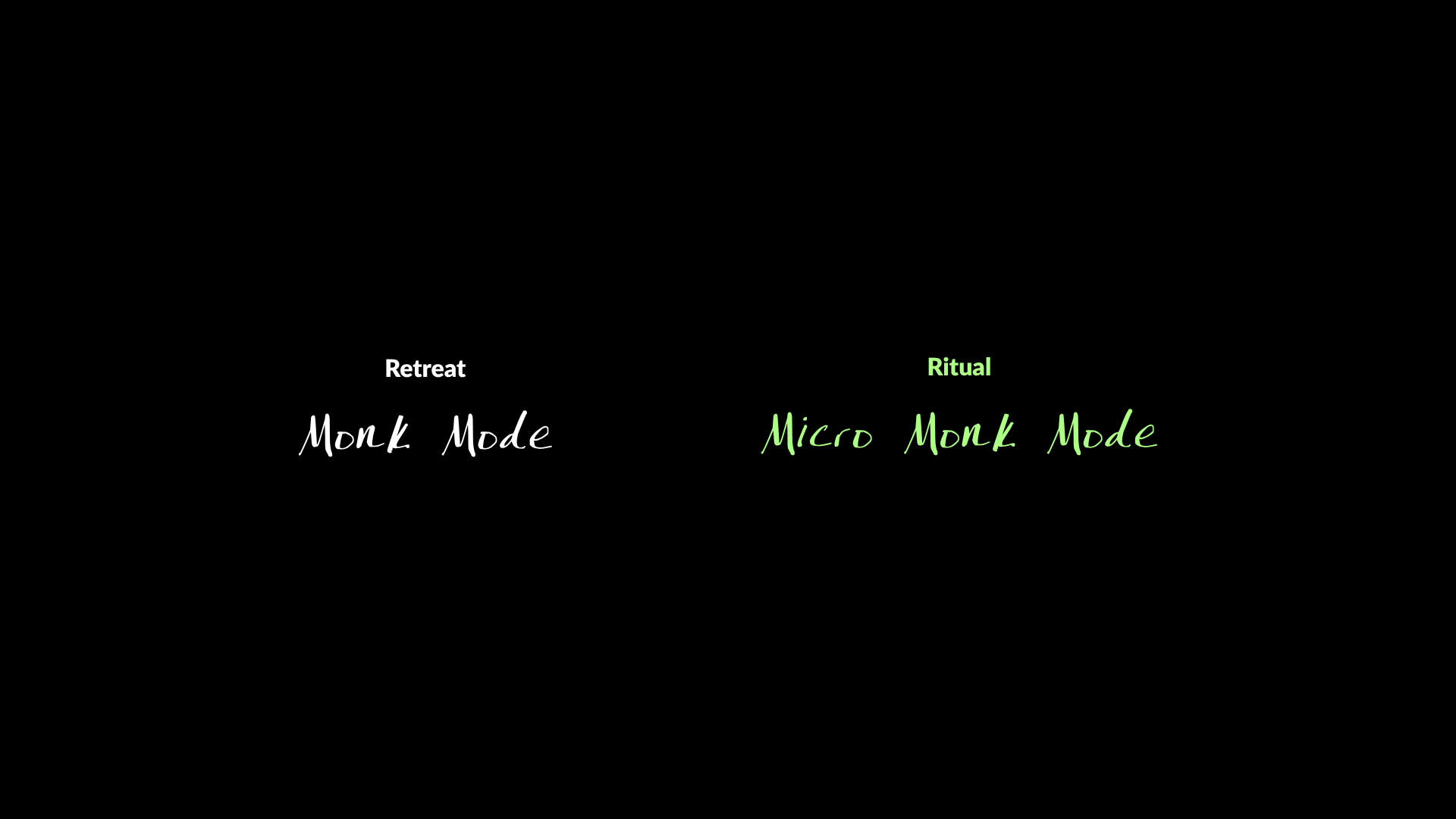
A retreat means leaving your life to find focus. A ritual means finding focus inside your life.
Monk Mode is a retreat. Micro Monk Mode is a ritual.
Same intensity, a different (and more accessible) delivery mechanism.
My Micro Monk Mode looks like this:
My window: 8 to noon, every day. No busy work during that block. No calls I don’t want to take. The only exception is an international call I genuinely want.
The type of work can change. Research, reading, writing, recording videos.
What doesn’t change: meaningful work only, never admin. Admin is what happens after noon.
The unbendable principle: energy over hours. It contradicts every other productivity system on the internet.
If your energy doesn’t match the flow, you stop. You don’t force it.
This is imperative.
Forced flow is contaminated product. It’s like cooking with ingredients that have gone off. The recipe doesn’t matter. The technique doesn’t matter. The output is compromised at the ingredient level. You can’t fix it with more time in the kitchen.
I learned this the hard way. I used to fill every available hour. Seven hours free between dad duties? Use all seven.
Time is precious. But making time the master instead of output quality is a failure.
If the energy isn’t there, the work suffers, and you produce something that looks done but isn’t.
Optimizing this way means the system doesn’t break if you lose a day. It doesn’t break if you lose a week, as long as you’ve been doing it long enough.
Tuesday I was sick. In bed all day. Nothing happened, and that’s the point.
The Proof
Here’s what protected flow actually produces. Take this however you want.
17 months. Nearly 200 coffee chats with total strangers. Zero ghosts.
The system handles the follow-up so flow time is never broken by admin. I built this once, and it’s run without changes for this long.
I built an entire typeface and website in a day. I built an email series I’ll run for a long time in three days. Connected everything in a couple of hours. Built once, and it stays built.
I work with a part-time video editor.
Flow has allowed me to create a schedule where we batch.
I record in flow, riding the wave of creation until I’m exhausted. Then I ship the work in the afternoon, during admin time, and he operates on his schedule.
He has freedom through structure and so do I. Both sides win.
The Trade-offs
Every other monk mode post ignores the cost or frames it as virtue.
The detox people say suffering is the point.
The disappear-for-months people don’t mention the downside.
Here’s the honest version of the trade-offs I make.
I’m a notoriously bad text responder. I’ll leave messages unread for up to 10 days. I always respond. But on my timeline, not yours.
My phone is face down or in another room when I’m in flow. I might miss a call from daycare. I accept this. If my not responding immediately doesn’t result in someone’s death, it will be fine. Inconvenient, but fine.
My partner is annoyed. She’s also adapted. Our love goes deeper than my response times.
I get fewer messages now. The ones I keep are enriching and worth both people’s time. Surface-level chat is gone, and that’s a gain. “Hey, how’s work?” “Great.” “Good weather by you?” That conversation wastes both our lives. I’d rather not have it at all.
These are deliberate, known costs of a system that produces results I can’t get any other way. I’d make every trade-off listed here again.
I Know What You’re Thinking
“Four hours a day? That’s not available to me.”
It wasn’t available to me either. That’s the whole point.
I accepted the design I was in for 16 years. The question is whether you want to redesign. If you don’t, that’s a valid choice. But “I can’t” usually means “I haven’t.”
The first step is deciding whether you even want four hours of flow.
“Great for you, you run your own business.”
True. But the principle transfers. Your window might be 90 minutes instead of 4 hours. The principle is the same: protect one block of pure flow inside your life, whatever size your life allows.
No matter how small the amount of time is, do one whole ass thing in that time.
I genuinely get more done in the first 90 minutes of my 4-hour flow time than I did in entire days in the previous 16 years.
“Isn’t this just time blocking with a fancy name?”
No. Time blocking organizes your whole day into categories. Micro Monk Mode protects one window at maximum intensity and lets the rest of the day be whatever it needs to be. It’s a rifle, not a schedule.
This is why I block the morning. My energy is highest then. I go until it runs out, step away for an hour, then do some admin to wrap the day or nothing at all.
“What if I block the time and I’m exhausted?”
Then stop. Energy over hours. This principle makes the system honest where others are dogmatic. The gurus say push through. I say: forced flow produces contaminated work. Come back tomorrow.
What Works For Me
This isn’t a step-by-step. It’s the combination I’ve perfected through months and months of iteration. Take what’s useful. Leave what isn’t. The principle is the thing.
It took me six weeks of trying this redesign before I felt consistently in flow. Accept that there will be an uncomfortable learning period. Internally commit to the process first, not immediate results.
This is tool agnostic. You could do this with a pen and a notebook. You could do it with your phone and a voice memo. You could do it by going for a walk and thinking. Flow has no boundaries in execution. What matters is the state, not the setup.
Don’t dilute this with tool recommendations. A coffee and a quiet environment are the floor. Test that first. Then add where it makes sense.
In other words, avoid needing a perfect environment to get into flow. It’s not about the environment first; it’s a state of mind first. You’ll learn as you go what aspects of your environment heighten your flow state.
The path of least resistance to achieve flow
The digital environment. Spartan. Basic needs, nothing extra. This applies to your room and your screen. One application open. One tab. Even if you have the self-control not to look at your inbox, remove it from view.
Zero notifications on your computer. Messages siloed to your phone only, and the phone app hidden behind the search bar so you have to type “phone” to see calls.
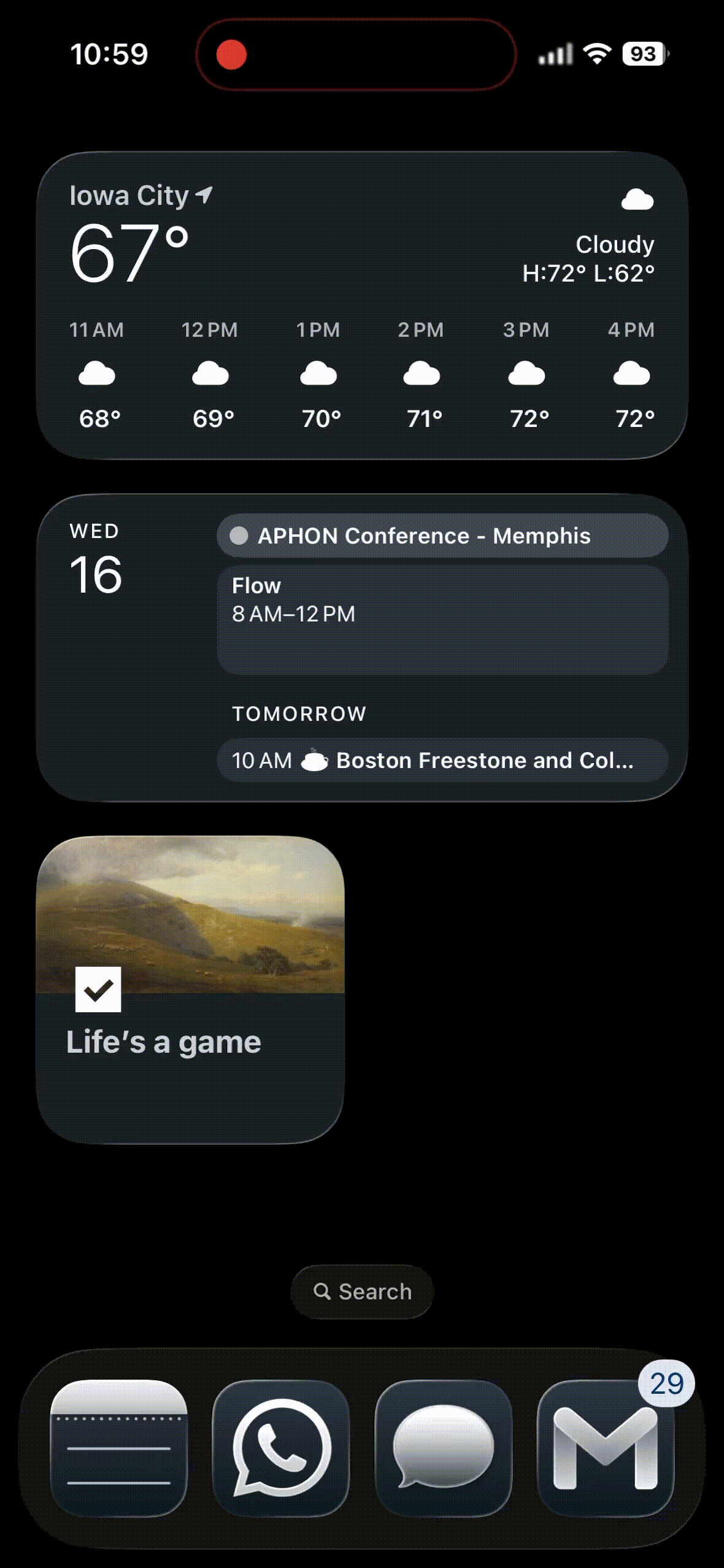
No banner notifications, ever. You see emails when you want to. Messages when you want to see them. Your computer is a protected space.
The physical environment. No specific workspace needed. I work from home with my dog on the couch. Door open or closed. Sometimes I use noise-canceling headphones with calming ambient music when my mind is busy.
There’s a YouTube channel called Oneness that plays these Tibetan-style sounds. That helps when the mind is loud—but it's not required.
Coffee is the only anchor. Sometimes the first sip starts the flow. Sometimes the whole cup is gone before I begin. Sometimes flow happens at a coffee shop surrounded by people. The ritual is simple: you’re alone, and you have coffee.
The on-ramp. There isn’t one. I’ve been doing this for 18 months. The body learns the state. Flow becomes automatic. Coffee, quiet, one tab, go. At first it takes effort. Eventually it’s instant, if the energy’s there.
The ritual compounds over time. Trust the process, yeah?
Boundaries. You don’t announce it. You start. People who don’t like it drop off. The messages you keep are worth both people’s time. You only work with people who match your energy. Clients who trust you respect the window. The friction lasts as long as you let it.
This is the hardest boundary to hold.
The afternoon. Whatever you want. Video games. More work if the energy is there. Admin. Parent mode. No guilt.
You put in a shift. If you did real flow for even an hour, you got more done than most people get done in a day. The afternoon is the reward for protecting the morning, not a continuation of the work just because hours are available.
Time will keep ticking whether you can produce excellent work or not. You gotta listen to your body and mind’s signals.
Don’t watch the clock. Get lost in flow.
Example: I’m writing this at 8:44 PM because the energy showed up. Some days the best work happens after the kids are in bed. The system doesn’t care when.
Your mirror
Here’s what I think actually happens. You watch the videos. You read the essays. You feel the pull to go monk.
And then you look at your life: the kids, the job, the calendar that doesn’t have a blank six months in it anywhere. And you think: not possible for me.
Then you do something worse than giving up. You make peace with it. “It is what it is.” You settle into the design you’re in. You tell yourself you’re being realistic.
You fill your days with busy work and call it being responsible. You pour the cup into eight tasks and wonder why nothing fills.
And you outsource the possibility of focused work to the people whose lives allow for it, as if that’s a life requirement and not a design choice.
That’s bullshit. I’m living proof.
Three kids under seven. Lifestyle business. Every school drop-off is mine. Sick kid this week. Can’t disappear for six months. And I produce more in four hours of protected flow than I used to in a full day of fragmented work.
I’m not special.
I committed to redesigning and didn’t let the trade-offs stop me from creating something that aligned with the work I wanted to do.
You have to believe you’re the best person to design your own system.
Not a guru. Not a CEO. You. Because you’re the only one who knows your life.
Picking up a productivity book or watching a video is like saying, “Give me the answer!” without knowing the question.
This takes faith.
You have to believe showing up is enough, even when you can’t guarantee you'll have the energy. The ritual, practiced enough, delivers you to the state. That’s 18 months of evidence talking.
And you have to trust that you’ll handle whatever comes. Sick kid on Tuesday? You handle it. The system doesn’t break. Missing a day doesn’t undo months of practice.
Somewhere in there, you stop looking for the next protocol. The videos stop calling to you. You stop outsourcing your schedule to people who don’t live your life.
That’s conviction. It starts with you. And it’s the only thing that was ever going to work.
The system you trust is the system you’ll run.
The system you run changes your life.
You can’t disappear. So don’t. Build something inside your life that works.
◬
If you want to watch this essay
↓
It’s free. No spam. Unsubscribe whenever.
This is the best Substack I’ve ever read