
You’ve heard, “just be yourself online.” What terribly right advice that gets you fuck all.
Like telling a depressed person to cheer up, “You think we don’t know we should be ourselves?” you shout into the void.
I’m not going to tell you how to be you. I’m going to tell you that there’s a cost to hesitating.
And I’d love to tell you that you can get by without having to give it all. With the right recipe and ingredients, you can save yourself from a few of the nastier bits.
But sorry, Chief, you’re cooked.
You may be wondering what this looks like, or you may already know but need a reminder.
Let’s call this out.
If you’re not semi-shitting yourself before you press publish, you’re outsourcing your expression.
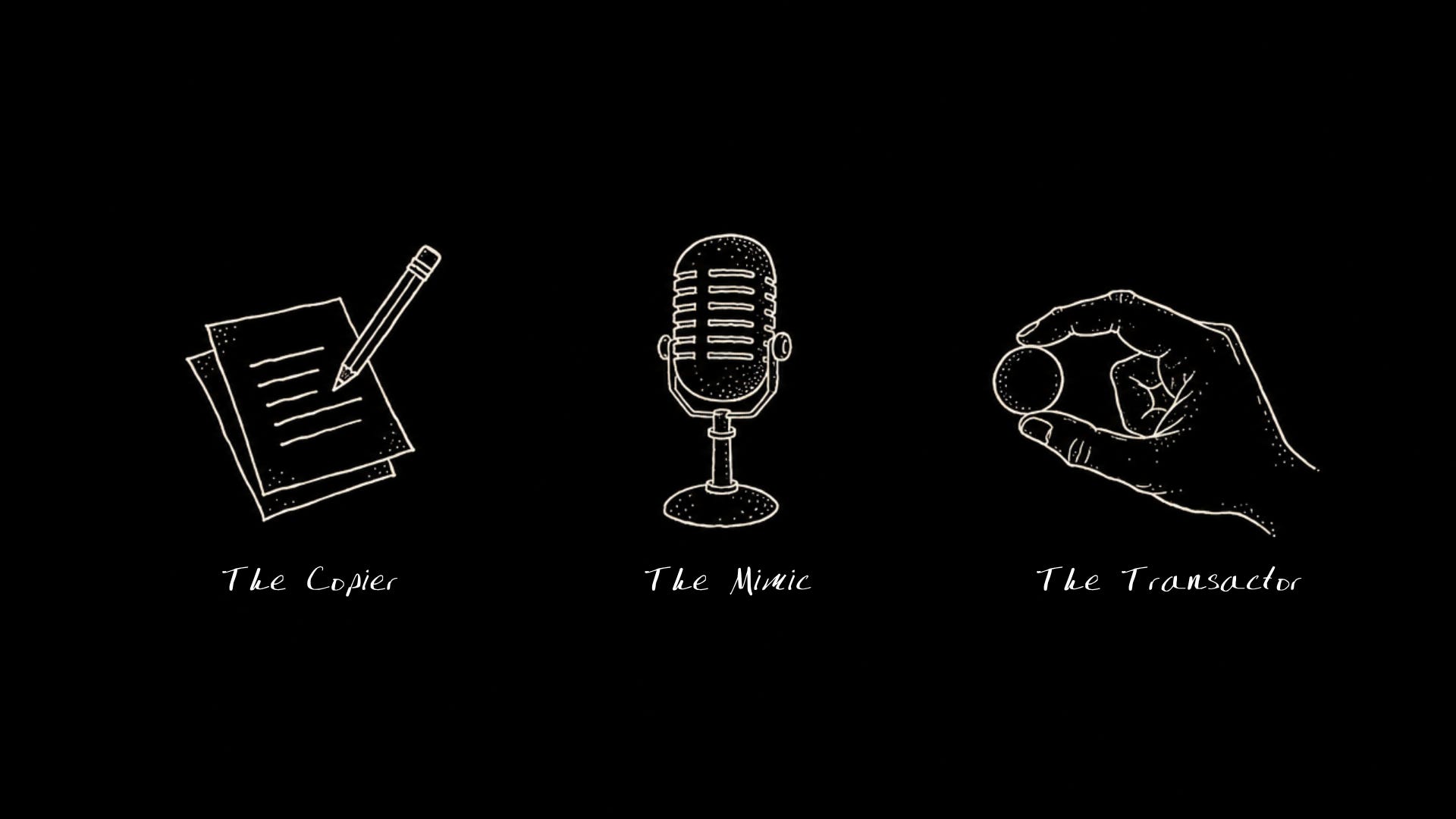
Here’s what outsourcing looks like (there are three versions of this plague):
First, copying someone else’s system. I know this one because I lived it. A creator with a 1M+ audience. An ads wizard who made you shut up and pay. A woo-woo master. A deca-millionaire leveraging YouTube. Copied ‘em all. Never for long. Ditched every one because, from day one, it felt like I was doing someone else’s version of life. They weren’t wrong to suggest them. The stuff they said was valuable. But I took it as a blueprint, not inspiration. I was trying to do it “right” by their standard instead of what felt “right” by mine.
The second: writing in a voice that isn’t yours. Performing authority you haven’t earned, in a register you don’t speak in, about ideas you haven’t tested. This is the coaching-industry default. Frameworks. Systems. Seven steps. The voice of someone who’s already reached every conclusion before the reader started reading.
The third: only saying what you think will perform. ROI-thinking. “I do this so you can give me this.” Every post is a transaction. Every word is engineered for engagement. The person doing this is transacting, not expressing.
Ew.
…
That ew isn’t rooted in judgment, you know that. It’s that we feel icky doing it, but we gotta make a living, and we somehow justify it as OK because if someone else is doing it, there’s our permission slip.
The most common form of despair is not knowing who you are. — Kierkegaard.
So, I was talking about cost…
When you withhold or outsource, you’re paying the ultimate penalty:
It’s called voluntary despair.
You may write in a journal, speak to AI, or voice memo into the ether (I do all three, by the way), but without a reflection back, it’s yearning whispers banking on the universe to reward you for wanting it enough.
It’s not, and never will be, enough.
You gotta take a risk.
Here’s what not taking a risk looks like:
You never put your own voice out where reality can reflect it. The stories in your head stay untested. You convince yourself you’re misunderstood, or invisible, or not capable of helping anyone. Those stories sit there, unchallenged, because you never gave the world a chance to confirm or break them.
This, my friend, is voluntary despair.
You chose it.
Every time you sanitized your opinion into nothing, every time you copied someone else’s format instead of inventing your own, every time you rewrote a post until it sounded like it could have come from any account with a profile picture and a course to sell, you chose it.
Or, worst of all, you kept the damn thing to yourself, and it never saw the light of day.
If you are posting through the lens of voluntary despair and it’s not hitting… well, that’s really the best-case scenario.
At least you don’t have to double down on a character you never wanted to be.
You can stay your melancholy self behind the scenes. Pour your heart into your journals. Ache for the corner of the pub where you fantasized about that girl you met in the coffee shop and never learned her name, but still think about twice a week and get lost in when drunk.
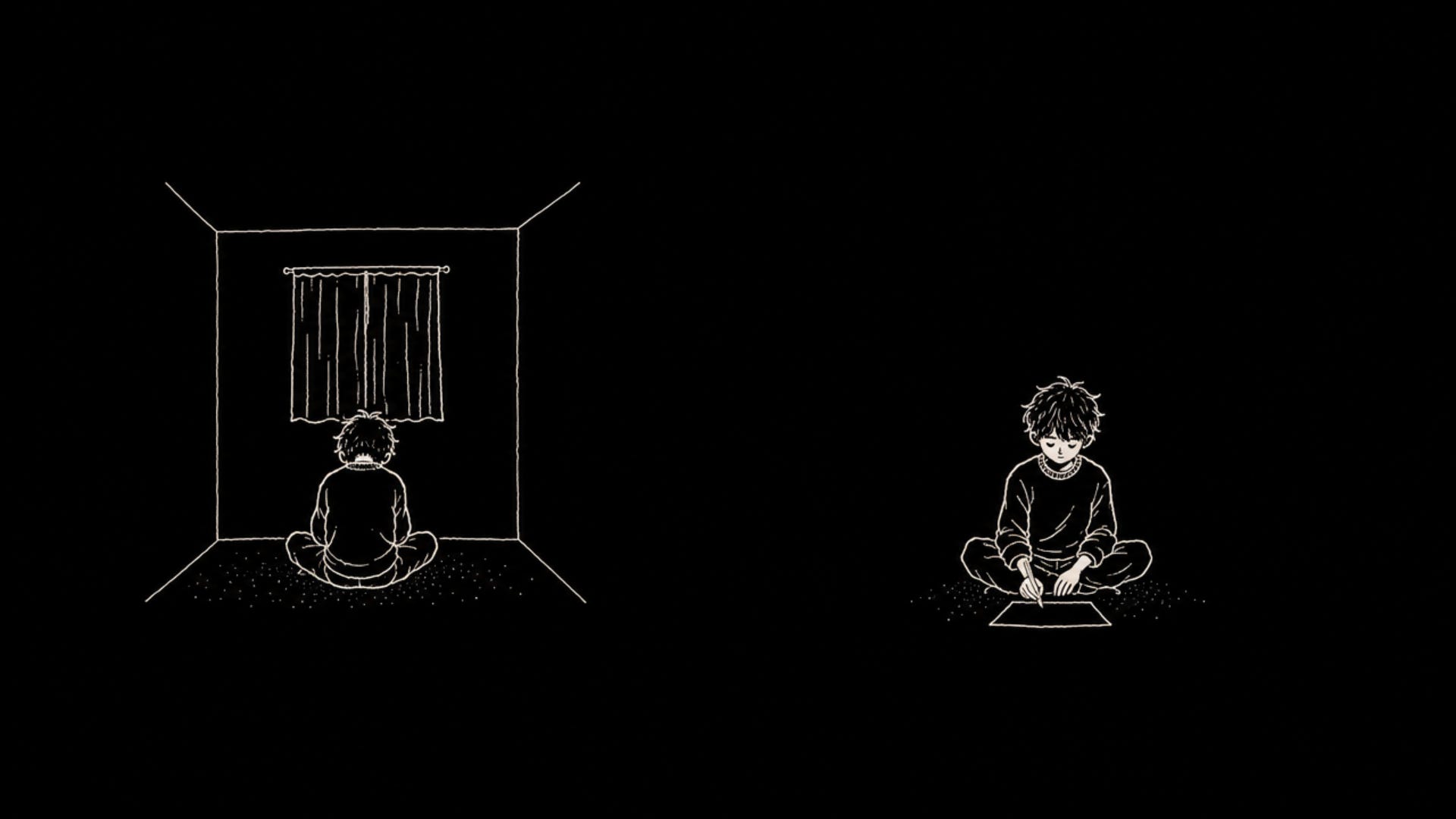
That’s a life. A real one. But it’s a life you’re living alone, with the curtains drawn. And the problem isn’t that no one can see you. The problem is that YOU can’t see you. The reality you create is your imagination expressed. If you only ever express based on other people’s points of view, their beliefs, their systems, you never see yourself. You only see their reflection.
In life, nothing is condemned. All is expressed.
Life does not care whether you call yourself rich or poor; strong or weak. It will eternally reward you with that which you claim as true of yourself. — Neville
The fear of true expression — your deep desires, your potential, your North Star, your conviction, your “What if?” — is what’s holding you back.
It’s not social media, the algorithm, or the ability to post that should be considered when expressing yourself.
That’s too complicated.
Choose your motivation for changing course, stop signing up for voluntary despair, and see what you’re made of.
Course #1 (the positive one):
You’re gonna die anyway. Never look back on your life and ask where your courage was.
Course #2 (the scary one):
Knowing that if you don’t express yourself publicly, you’ll only ever reinforce the stories in your head. The stories you’ve convinced yourself are true but have no basis for. They may be true. They may not be. How would you know without the expression?
And the internet is full of “never be afraid of the blank page” or the “blinking cursor,” but that’s too shallow.
You’re complex, and you’re thinking beyond it.
The fear is of people’s response, or worse, the lack of one.
You think you’ll be misunderstood (“I’m different, no one gets it”) or nonexistent (“I’m worthless, a speck floating in space”).
Here’s the liberating sentence you need to hear: Nobody cares (including you).
Over coffee, I talked with my son’s principal about the old days.
Neither of us misses high school, but we used to play each other in sports. Trading names, moments, talking about high school reunions we’d gone to and not gone to, where people still want to refer to you as the football star or basketball star.
And he expressed that feeling we all have as teens… the spotlight is on us.
Everyone is watching.
Speaking of imaginary stories we tell ourselves…
If you were sitting in the room with me right now and I asked what you had for lunch last Tuesday, you’d have no damn clue.
This is your benefit.
You don’t even care that much.
No one cares about you. Specifically, personally, individually. No one is waiting to cancel you. No one is lying in bed thinking about your post.
And if you have a core belief strong enough to say the thing that goes against the grain, there are always two sides to every story, and you will have enough support from the people who believe what you believe.
If you’re afraid some people will disagree, good!
No one ever hit their potential by hanging out in the middle.
If you believe it, say it. Don’t hold it.
You’re someone with the skills to help people, desperately wanting to, but held up by a fear of reprisal that is highly unlikely to come.
You’re keeping yourself from what you’re truly meant to do. If you don’t take the risk, who will?
But here’s the other side of “no one cares.”
No one cares about you specifically. But expression matters enormously to the collective.
When everyone is performing, the culture is dictated by something as fair-weather as the daily wind. No moral compass. No deeper drive. No clear reason for any of it.
Growth for growth’s sake is the ideology of the cancer cell. If we perform for the sake of performance or reward, we are transacting.
Doesn’t that feel hollow just to read?
When one person stops performing and speaks from their actual self, something breaks open.
They’re not giving anyone permission. You need no permission at all.
That’s the mindset of the waiter (think time, not food).
It says: “What have you to lose?”
And if you feel misunderstood, understand yourself first, and tell others how to understand you.
For God’s sake, don’t conform to something you already don’t feel resonant with.
You’re not for everyone. That’s the point.
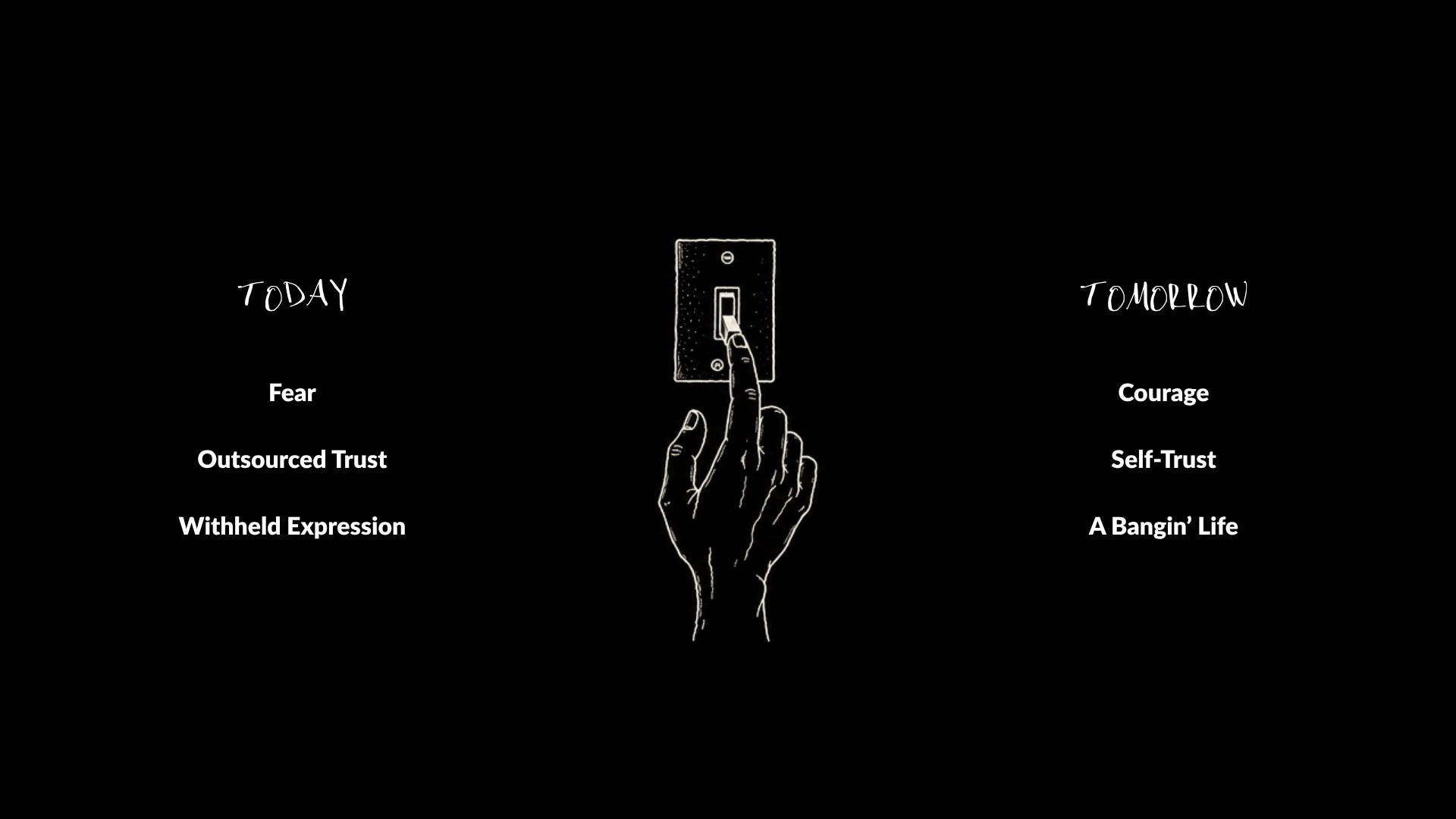
Courage can be taught. This essay can be a light switch to get started.
If you need a step… model what your future self would be proud of.
Would that person sit here and wait? Would they transact? Would they fucking care how much money was in the account or who disliked them if they had 5 more hours on this earth?
It’s not about “out there.” It’s about “in here.”
Think of yourself as the most important audience member for anything you produce, much like a journal. You know it’s for no one but yourself, but you still want to look back and read old entries.
Why?
Because you can find fascination in the pages. Be fascinated with your own life, and with what life has to offer.
Then talk about it.
Through time, your life experience will create your philosophy.
The exercise itself is valuable in its own right because you’ll have discovered yourself.
And that is the only person that matters when it comes to living a full life.
A bangin’ life.
Those who know others are intelligent;
those who know themselves are truly wise.
— Tao Te Ching
I bring this up over and over and over again in conversations, essays, and videos because it terrifies the hell out of me.
Bronnie Ware spent years caring for people in their last weeks of life. She asked them about their regrets. The number one regret, more than any other, was this: “I wish I’d had the courage to live a life true to myself, not the life others expected of me.”
The regret was courage. The regret was that they never found out who they were when they stopped performing for other people’s expectations.
Every path is now a gamble. The only question is whose judgment you’re wagering on—the rulebook’s, or yours.
You can outsource your expression and stay safe. Copy the systems. Perform the authority. Transact for the engagement. And you will die with the same regret as every person who ever lay in a bed and realized they never tested the stories they told themselves about who they were.
You will die not knowing what you were capable of.
Or you can express.
Badly, at first. In a voice that’s still finding itself. With posts that don’t perform because they’re yours and not someone else’s. And you will be alive in a way that most people, including possibly the version of you reading this right now, are not.
This doesn’t mean you don’t ever get better. Quite the opposite, actually, and here’s my own very real example.
I went pro on September 7.
I spent $500+ on a tool called Eden. I’d been feeling for a while that I needed to take posting seriously but still felt like I didn’t have the tools to do it well.
I’d thought about Eden for some time and, as often happens, you think of something and then all of a sudden it feels like it drops in your lap.
I pulled the trigger and spent the money as my final act of not taking it seriously.
From that moment, I was all in.
Before that, I treated my expression like a wishy-washy thing.
I scoffed at playing the social media game for so long. Telling my editor the algorithm won’t dictate what I do. Fuck it, etc.
But I realize how immature it was to think, “just post whatever,” when there are clearly opportunities to do it better and help more people.
If you’re not improving, you’re not giving your philosophy the best chance to get found. It only helps people if they can find it.
I have a long way to go before I’m a good pro. But I stopped pretending it didn’t matter. It does matter. It’s what I owe myself. To get better so I can help more people.
Every post I’ve done in the last 60 days, I thought to myself: that’s my voice, I believe that, I hope it does well, but I don’t need it to. Then I learn and get better with each piece. I’m my own audience, and my philosophy’s depth is my master. Everything else is bonus and lessons. With this approach, I do more, help more, and try my absolute fucking best with no distractions. Because if even one person outside of me can find value in it, that feels like turning metal into gold. It’s alchemy.
↑
Sent this quick demo to some people I met on a networking call. This is a very high-level overview of Eden.
Were you expecting black or white? That you post a raw journal entry and not care? You can. But are you serious about your power?
We’ve made marketing God. We’ve made systems God. We treat workshop notes like scripture, productivity frameworks like commandments, and social media strategies like the only path to salvation.
They’re information, nothing more. Your discernment. Your choice. That’s God.
Your ability to know what’s for you and what’s not for you is God.
We treat information as the holy of holies. We should treat it as material that helps us become the holy of holies more deeply. Information serves you, not the other way around.
This is why copying systems fails. The systems aren’t bad. The problem is you’ve given the system too much power.
You’ve outsourced your discernment to someone else’s framework. You’ve decided that their “right” is more authoritative than yours.
And every time you do that, you move one step further from finding out who you actually are.
That’s why the Bronnie Ware thing terrifies the hell outta me.
To see your current situation as real is to deny all things are possible.
I’m no different than you.
Look at my social media. It’s not one banger after another of viral blessings.
But I’ll tell you something…
Every damn time I’m about to press publish, I get nervous.
Then I do it anyway.
That’s the only difference between us. The ONLY difference.
So, if you want my take on where to start, it’s this…
You’ve got a journal. Read back. Or if something is already popping in your mind that you’re nervous to share, that’s the place to begin.
The thing you’re afraid to express. The thing that fucking matters. The thing that, if you gave it the breath, would make you feel alive.
Express it.
It doesn’t have to be a Substack article or online at all. Put it in front of someone you trust. Or go all in and actually write it and publish it.
Get it out because it’ll prove something to you.
And this is my promise: you’ll feel more capable. You’ll feel more alive. You’ll understand that fear is mostly a story and not a terminal disease.
Express it. And realize you’re capable of far more than you’re allowing.
And understand that when you do, you’ll have to do it again—every day until you die.
It’s more debt than liberation.
But it’s chosen debt.
Sounds better than voluntary despair.
◬
-Colby